
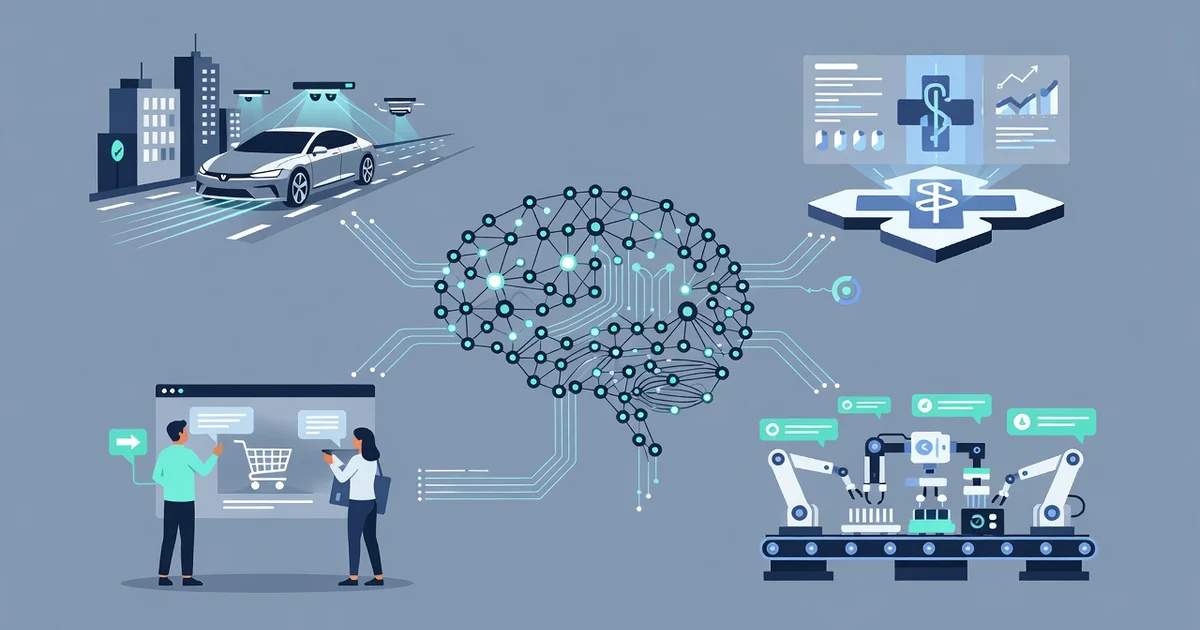
Machine learning is everywhere you look, from the recommendations on your favorite streaming service to the spam filter guarding your inbox. Simply put, it’s a branch of artificial intelligence that lets computers learn from data and improve at tasks without being explicitly programmed for every rule.
But how does it actually work in the real world, and what can it do for you? In this article, we’ll break down machine learning in plain language, explore the most common types, and show you practical examples of how it’s used today — so you can spot it in action and understand its impact on your daily life.
Introduction
Machine learning is one of those terms that shows up everywhere—in news headlines, job listings, product pitches, and casual conversation. Yet many people nod along without a firm grasp of what it actually means. At its core, machine learning is a branch of artificial intelligence that enables computers to learn from data and improve at a task without being explicitly programmed for every possible scenario. Instead of writing rigid rules for every situation, developers feed algorithms large amounts of examples, and the system finds patterns on its own.
This article explores What Is Machine Learning and How Is Used Today with clear, practical guidance. You will learn the fundamental vocabulary, see real-world applications across industries, and walk through a step-by-step approach to applying machine learning concepts in your own context. Understanding the fundamentals of What Is Machine Learning and How Is Used Today helps you make informed decisions—whether you are a business owner evaluating tools, a student exploring a career path, or a professional trying to separate genuine capability from marketing hype.
The field moves quickly, but the core ideas are surprisingly stable. Once you understand how models learn from data, how they are trained and evaluated, and where they succeed or fail, you can navigate new developments with confidence. Reliable information and consistent habits lead to better long-term outcomes, and that principle applies whether you are building a model or simply deciding which AI-powered product to trust.
Key Concepts
Before diving into applications, it helps to clarify the essential building blocks. Machine learning systems share a common structure: data goes in, a model processes it, and a prediction or decision comes out. The model improves by comparing its outputs to known correct answers and adjusting internal parameters—a process called training.
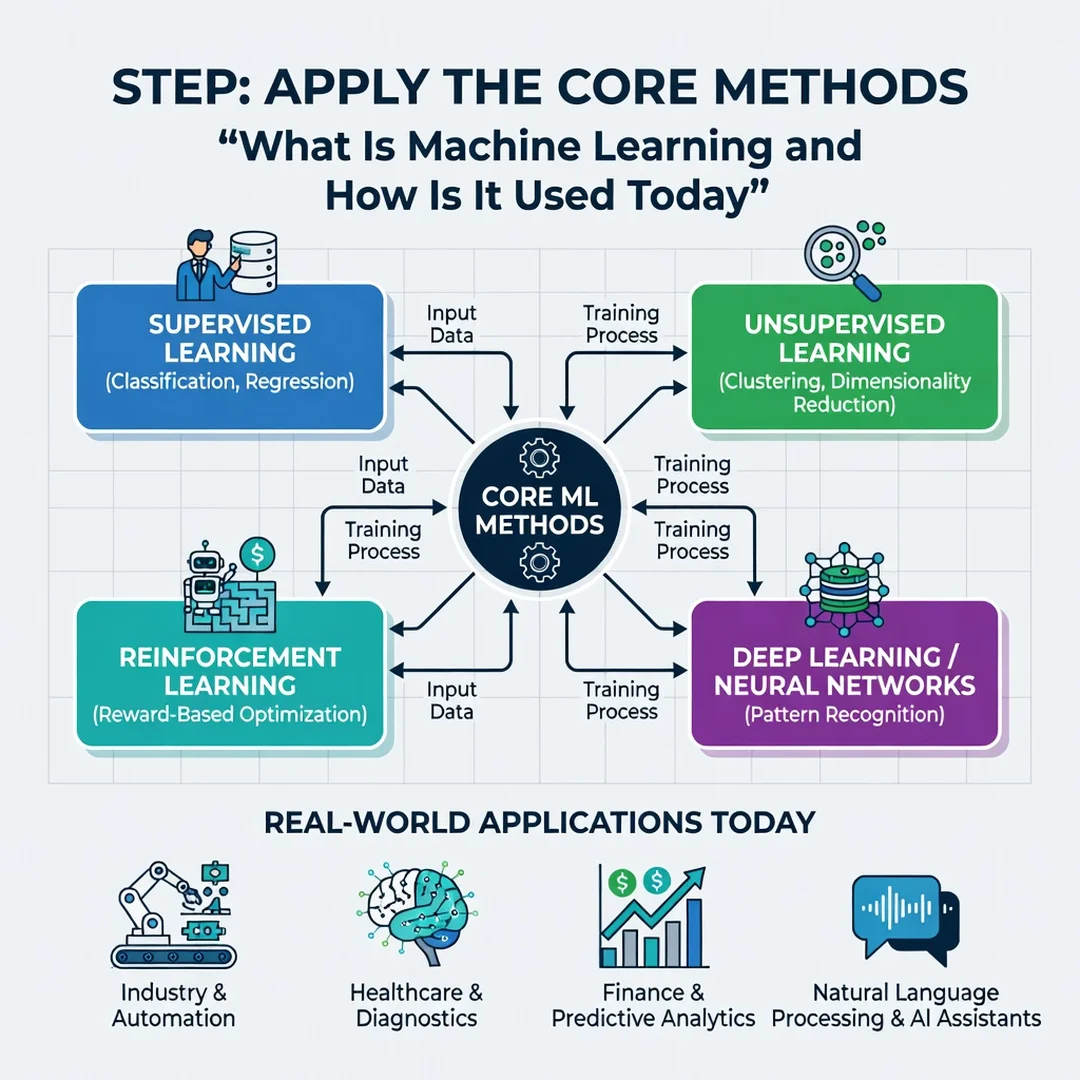
- Supervised learning: The model learns from labeled examples. For instance, emails marked as “spam” or “not spam” teach a filter to classify new messages. This is the most common approach in business applications.
- Unsupervised learning: The model finds structure in unlabeled data. Clustering customers by purchasing behavior is a typical example. No one tells the algorithm what the groups should be; it discovers them.
- Reinforcement learning: An agent learns by interacting with an environment and receiving rewards or penalties. This powers game-playing AI and some robotics systems.
- Features and labels: Features are the input variables (e.g., age, income, past clicks). Labels are the target outputs you want to predict (e.g., will the customer buy?).
- Training, validation, and test sets: Data is split so the model can learn on one portion, tune on another, and finally be evaluated on unseen data. This prevents overfitting—memorizing the training data without generalizing.
- Model evaluation metrics: Accuracy, precision, recall, and F1 score help you judge performance. The right metric depends on the problem; a cancer screening model, for example, prioritizes recall to avoid missing positive cases.
These concepts form a shared language. When you read that a company “trained a model on millions of records,” you now know they fed labeled examples through an algorithm, adjusted parameters, and measured results against a held-out test set.
Deep Dive
Machine learning is already embedded in daily life, often invisibly. Understanding where it operates helps you assess both its value and its limitations.
Everyday consumer applications
Recommendation engines on streaming platforms and e-commerce sites use collaborative filtering and deep learning to predict what you might enjoy next. Voice assistants rely on speech recognition models that convert audio to text and then interpret intent. Photo apps group faces and detect objects using convolutional neural networks. Even your email inbox uses machine learning to sort messages, flag phishing attempts, and suggest replies.
Business and industry
In healthcare, machine learning aids in medical imaging analysis, drug discovery, and patient risk stratification. Financial institutions use it for fraud detection, credit scoring, and algorithmic trading. Manufacturers apply it to predictive maintenance, anticipating equipment failures before they happen. Retailers forecast demand, optimize inventory, and personalize promotions. Logistics companies route deliveries more efficiently by learning from traffic and weather patterns.
Limitations and ethical considerations
Machine learning is not magic. Models inherit biases present in their training data, which can lead to unfair or harmful outcomes in hiring, lending, or policing. They can also be brittle—performing well in controlled tests but failing in the messy real world. Privacy concerns arise when personal data trains models without clear consent. And because many advanced models are “black boxes,” explaining their decisions to regulators or customers remains a challenge.
Recognizing these limits is part of understanding the field. A model is only as good as its data, its design, and the oversight applied to it.
Best Practices
Whether you are implementing machine learning or evaluating it as a consumer or decision-maker, certain habits improve outcomes.
- Start with the problem, not the technology. Define the decision you want to improve. Machine learning is a tool, not a goal.
- Invest in data quality. Clean, representative, and well-labeled data matters more than a fancy algorithm. Garbage in, garbage out remains true.
- Use a baseline. Compare your model against a simple rule or human judgment. If it cannot beat the baseline, reconsider.
- Validate on unseen data. Always test on data the model has never encountered. Cross-validation provides a more robust estimate of performance.
- Monitor after deployment. Data distributions shift over time. A model that worked last year may degrade this year. Set up regular performance checks.
- Document and communicate. Record how the model was built, what data it used, and its known limitations. Transparency builds trust.
- Keep humans in the loop for high-stakes decisions. In medicine, law, and finance, machine learning should inform, not replace, expert judgment.
These practices apply whether you are a data scientist, a product manager, or a citizen interacting with AI-powered services.
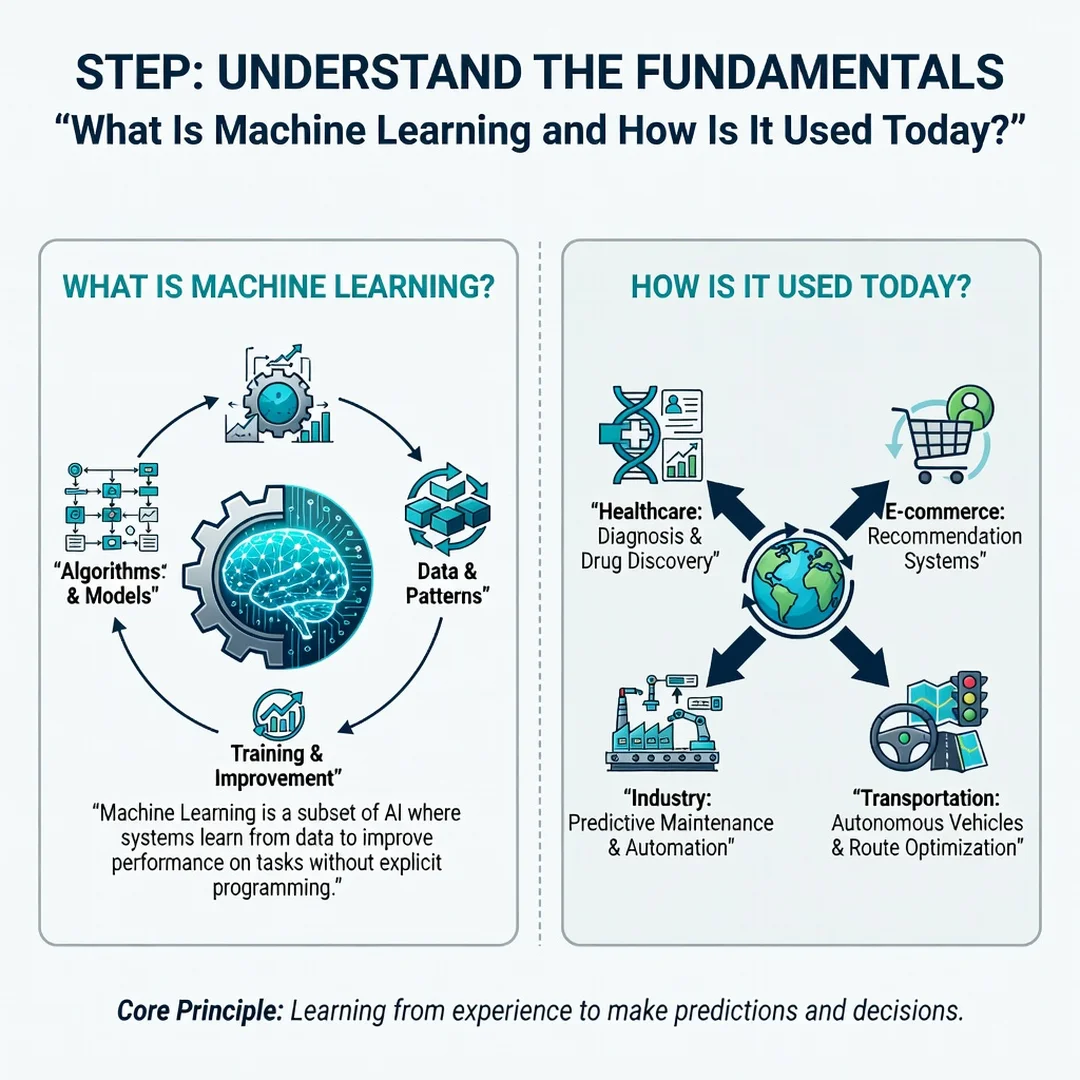
Step 1: Understand the fundamentals
Begin by learning the core vocabulary: supervised versus unsupervised learning, features, labels, training and test sets, and common metrics. Read introductory articles, take a short online course, or work through a beginner tutorial. You do not need a PhD—just enough literacy to ask good questions and recognize when someone is overselling.
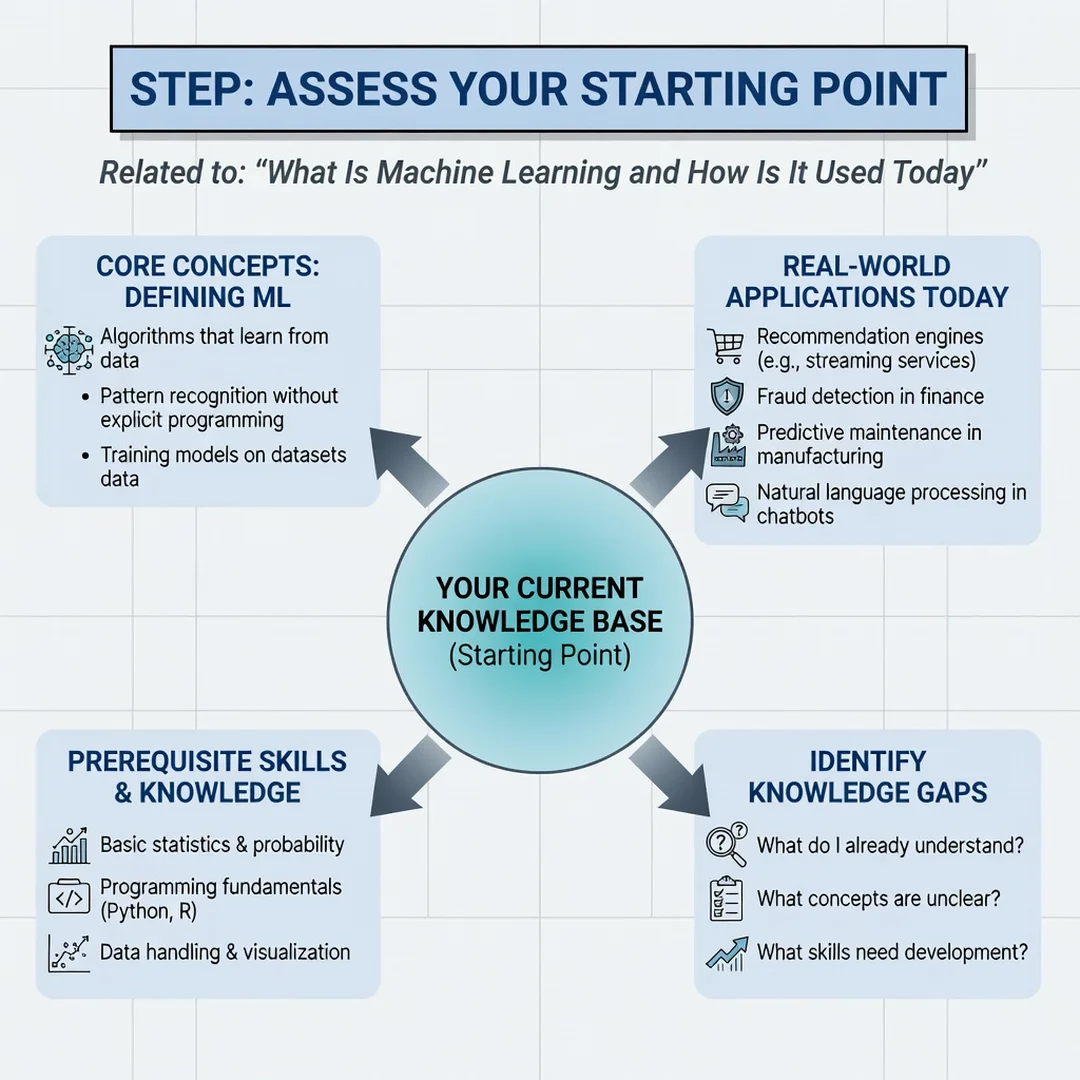
Step 2: Assess your starting point
Evaluate your current knowledge, resources, and data access. Are you a complete beginner? Do you have historical data with clear outcomes? What tools are available to you, from spreadsheet add-ons to cloud platforms? Honest assessment prevents wasted effort and helps you choose a realistic first project.
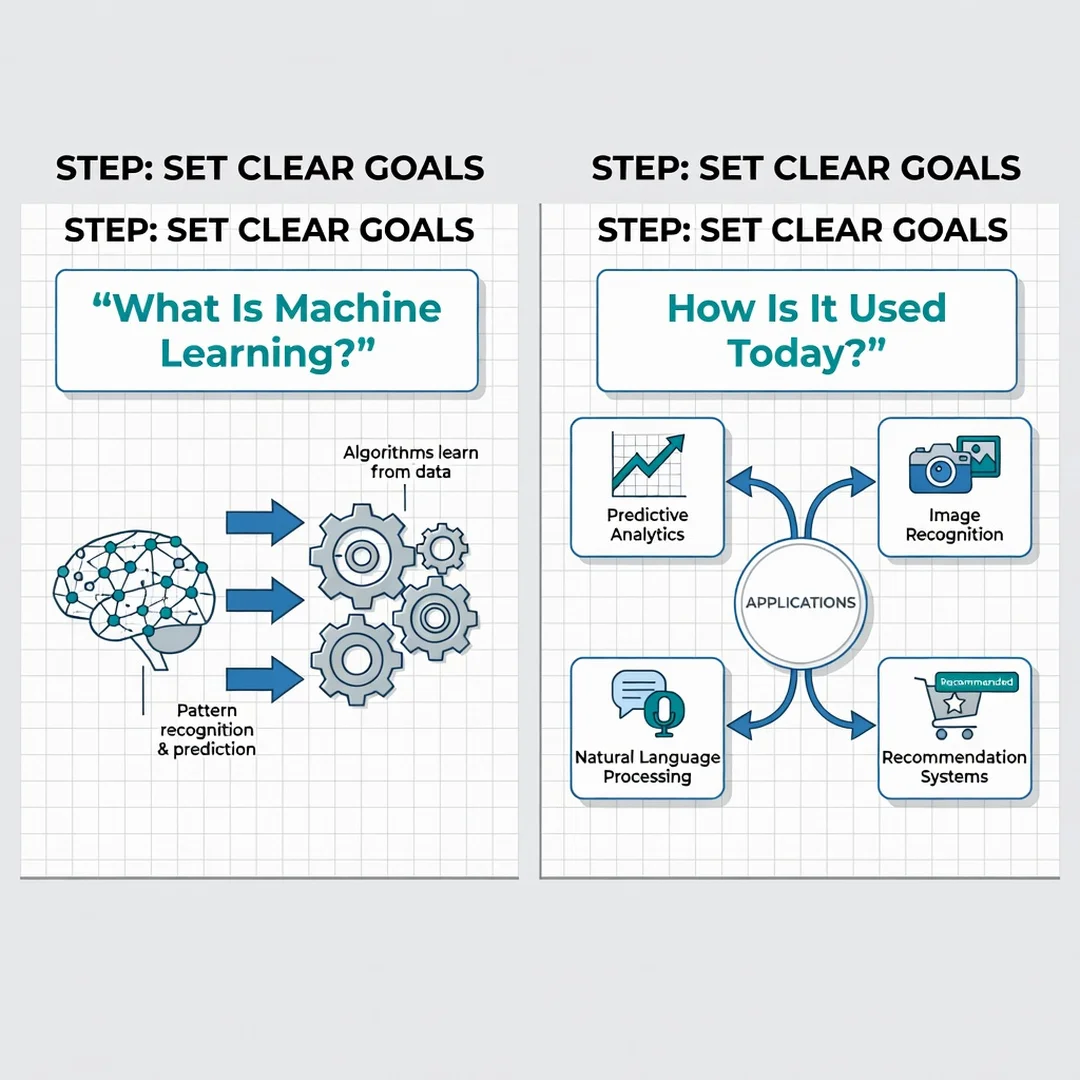
Step 3: Set clear goals
Define what success looks like. Instead of “use machine learning,” aim for “reduce customer churn by 10% within six months” or “automatically categorize support tickets with 90% accuracy.” Specific, measurable goals guide your choices and make it easier to evaluate progress.
Step 4: Gather necessary resources
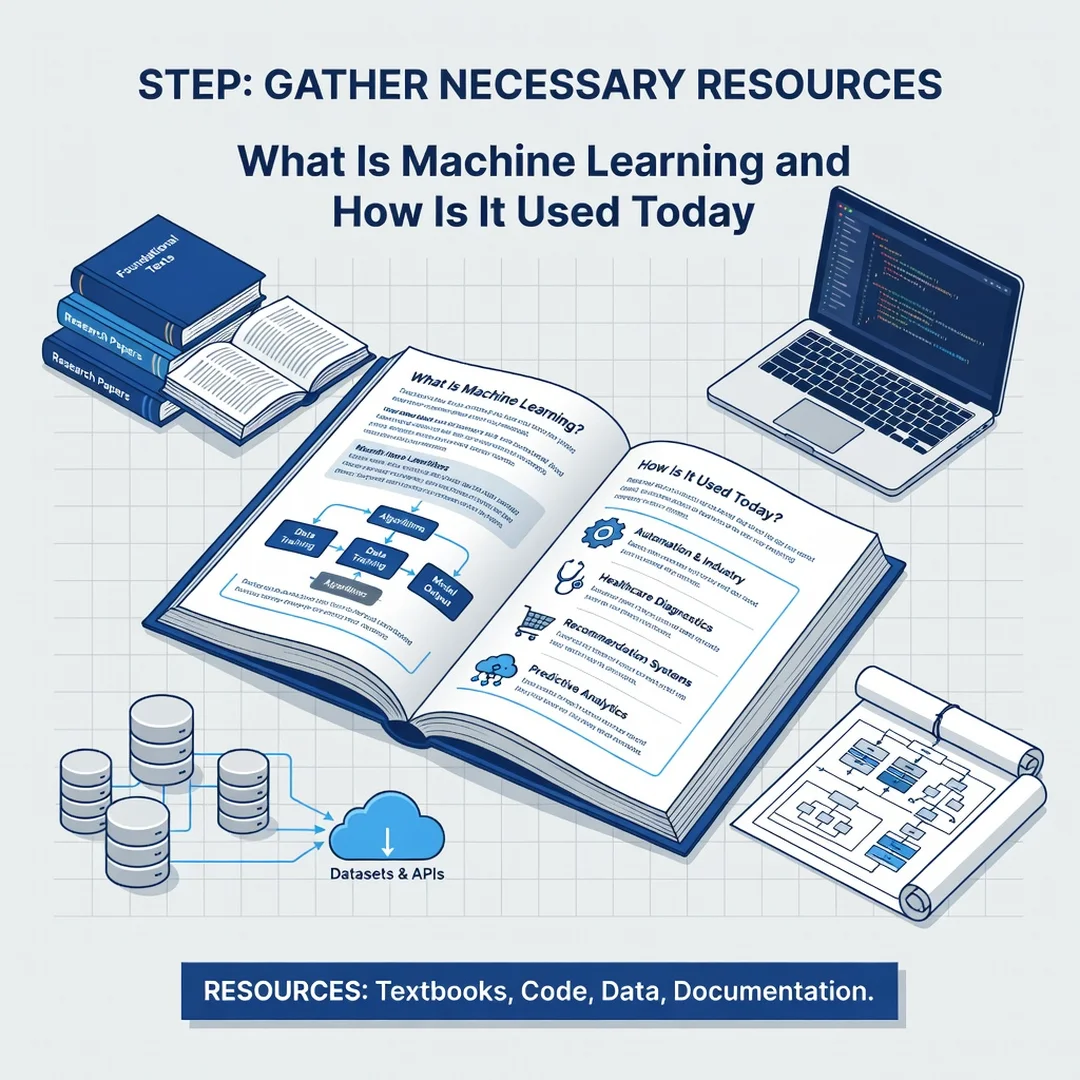
Collect the data, tools, and people you need. This might mean cleaning a dataset, selecting a platform like scikit-learn or a cloud ML service, and identifying a mentor or collaborator. Budget time for data preparation, which often consumes most of a project.
Step 5: Apply the core methods
Start simple. Try a basic model such as linear regression or a decision tree. Split your data, train the model, and evaluate it on a held-out set. Iterate by adding features or trying different algorithms, but always compare against your baseline. Document what you learn at each step, and share results with stakeholders to keep the project grounded in real needs.
FAQ
What should I know about What Is Machine Learning and How Is It Used Today?
You should know that machine learning is a practical technology already integrated into daily life, from recommendations to fraud detection. It learns patterns from data rather than following hand-coded rules. Its effectiveness depends on data quality, problem framing, and ongoing oversight. It is powerful but not infallible, and it raises important ethical and privacy considerations.
Who is this guide for?
This guide is for anyone seeking clear, actionable information about machine learning—students, professionals, business owners, and curious readers. No technical background is required. If you want to understand what machine learning is, where it is used, and how to engage with it responsibly, this article provides a solid starting point.
Conclusion
Machine learning is transforming how we work, shop, communicate, and make decisions. By grasping the.
You now have a solid foundation for What Is Machine Learning and How Is It Used Today. Apply the best practices above and revisit this guide as your needs evolve.